Comparing JavaScript, Golang, and Rust: A Developer’s Perspective
As modern software development continues to evolve, developers have a multitude of languages to choose from when building applications. Three of the most prominent languages in today's ecosystem are JavaScript, Golang (Go), and Rust. Each of these languages has unique features and strengths, making them suitable for different types of projects and use cases.
In this article, we'll dive into a comparison of JavaScript, Golang, and Rust, focusing on their performance, use cases, ease of learning, and developer experience.
1. JavaScript
Overview
JavaScript is a dynamically typed scripting language that has been the backbone of web development for many years. It is primarily used for creating interactive front-end web applications, but with the advent of Node.js, it has become a powerful language for back-end development as well.
Strengths of JavaScript
- Ubiquity: JavaScript is the most widely used language for web development, supported by all modern web browsers. It's the standard language for building dynamic and interactive websites.
- Event-Driven & Asynchronous: JavaScript excels in handling asynchronous operations thanks to its event loop, making it perfect for I/O-bound tasks such as API calls and file handling.
- Huge Ecosystem: The JavaScript ecosystem is massive. With tools like npm (Node Package Manager), there are libraries and frameworks available for almost every use case—whether you're building a front-end with React or a server-side application with Express.
- Single Language for Full Stack Development: JavaScript enables full-stack development with the same language for both client and server-side code (thanks to Node.js), leading to a more cohesive developer experience.
Weaknesses of JavaScript
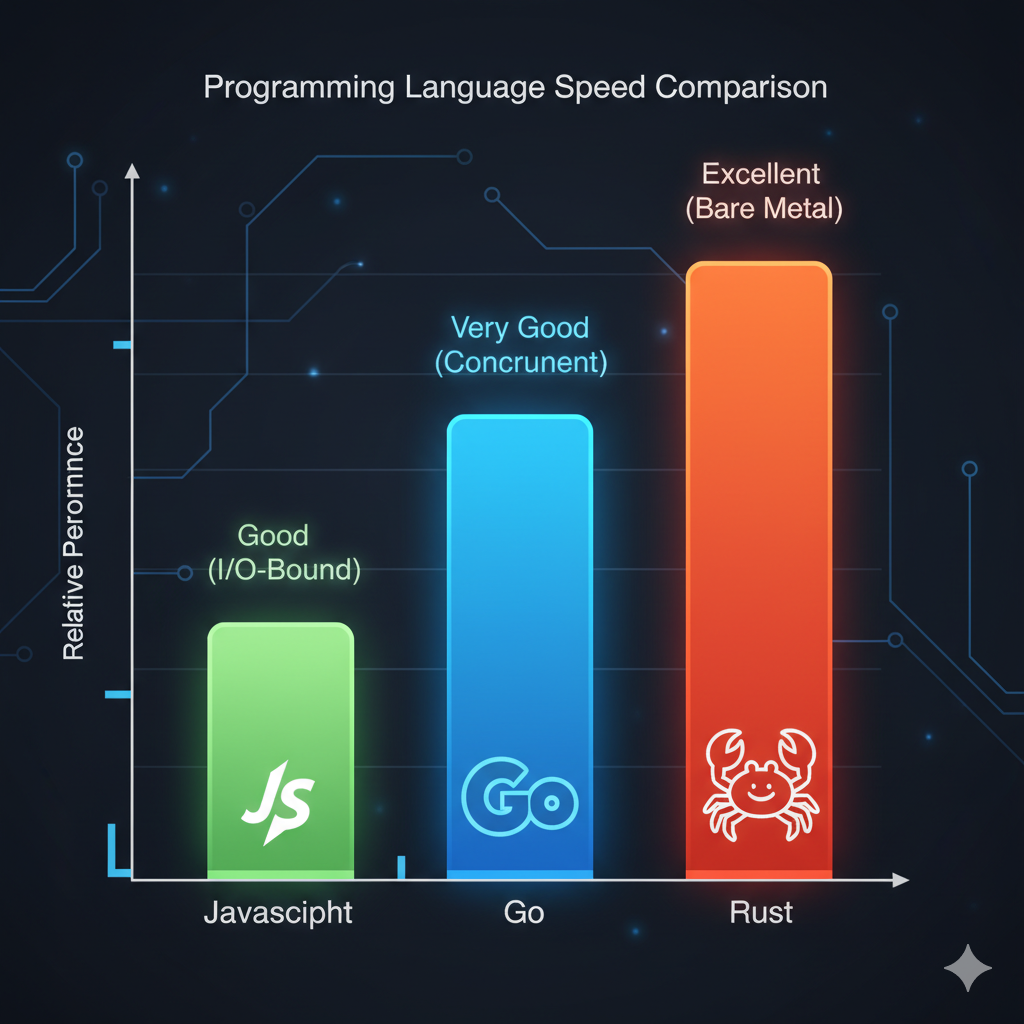
- Performance: While JavaScript performs well for most web applications, it is not as fast as statically-typed compiled languages like Rust or Go. For CPU-bound tasks, JavaScript can become slow and inefficient.
- Dynamic Typing: JavaScript’s dynamic typing can lead to runtime errors that are difficult to catch during development. This can make the language error-prone in large codebases, though TypeScript (a statically typed superset) can mitigate some of these issues.
Use Cases
- Web Development: JavaScript is the foundation for web development, from client-side interactivity (via DOM manipulation) to server-side operations (via Node.js).
- Single-Page Applications (SPAs): With frameworks like React, Vue.js, and Angular, JavaScript is the go-to language for building dynamic SPAs.
- Real-time Applications: JavaScript’s non-blocking, asynchronous nature makes it perfect for real-time applications like chat apps, live notifications, and collaborative editing tools.
2. Golang (Go)
Overview
Go, also known as Golang, is a statically typed, compiled language created by Google. It is designed for simplicity and high performance, making it an excellent choice for building fast, scalable systems.
Strengths of Go
- Simplicity: Go’s syntax is minimal and easy to understand. It avoids the complexities of other programming languages, such as object-oriented programming, and focuses on simple concepts, making it easy for developers to pick up.
- Concurrency: One of the standout features of Go is its built-in concurrency model using goroutines and channels. This allows developers to handle multiple tasks concurrently without the complexities of threads or callback hell.
- Fast Performance: Go is a compiled language, which makes it faster than interpreted languages like JavaScript. It's well-suited for high-performance applications, especially in cloud services, microservices, and networked applications.
- Strong Standard Library: Go has an extensive standard library, especially for web and network programming. Libraries for handling HTTP requests, JSON encoding, and other networking tasks are included right out of the box.
- Built for Scalability: Go is designed with scalability in mind, which makes it a great choice for building microservices and cloud-native applications.
Weaknesses of Go
- Lack of Generics: Go doesn’t have generics, meaning you can’t write reusable code for different types without resorting to interfaces or code duplication. However, this has been addressed in Go 1.18 with the introduction of type parameters (a form of generics).
- Garbage Collection: While Go’s garbage collection is efficient, it may still introduce latency in certain performance-critical applications (like real-time systems).
Use Cases
- Microservices: Go’s simplicity, concurrency model, and performance make it a top choice for building microservices architectures and cloud-native applications.
- Network Programming: Go is widely used for building networked services like load balancers, proxy servers, and HTTP servers.
- Command-Line Tools: Go’s fast compilation times and lightweight binaries make it ideal for building powerful CLI tools.
- Distributed Systems: Go's built-in concurrency and ease of handling multiple processes make it suitable for distributed systems, like Kubernetes, which is written in Go.
3. Rust
Overview
Rust is a systems programming language that focuses on safety, concurrency, and performance. It provides low-level control over system resources, similar to C and C++, but with memory safety and thread safety guarantees.
Strengths of Rust
- Memory Safety Without a Garbage Collector: One of Rust’s biggest strengths is its ownership model, which ensures that memory is managed safely without the need for a garbage collector. This prevents common bugs like null pointer dereferencing, dangling pointers, and memory leaks.
- Performance: Rust is designed for performance. As a compiled language, it produces fast, efficient binaries that rival C and C++.
- Concurrency: Rust’s concurrency model allows safe multi-threading, ensuring that data races are prevented at compile time, which eliminates many concurrency bugs that are common in other languages.
- Tooling: Rust has a strong ecosystem, with tools like Cargo (package manager and build system), rustfmt (automatic code formatting), and Clippy (linter) providing an excellent developer experience.
- Cross-Platform: Rust is highly cross-platform and can be used to build applications for a wide range of platforms, from operating systems to web applications (via WebAssembly).
Weaknesses of Rust
- Steep Learning Curve: Rust’s ownership model and its focus on memory safety can be difficult to grasp at first, especially for developers coming from garbage-collected languages like JavaScript or Go.
- Longer Compilation Times: Rust is known for its long compilation times, especially for larger projects. However, the added benefit of safety and performance can outweigh this downside.
Use Cases
- Systems Programming: Rust is ideal for building low-level systems software, such as operating systems, device drivers, and high-performance applications.
- WebAssembly: Rust has excellent support for WebAssembly, making it a great choice for building fast web applications that run directly in the browser.
- Game Development: Due to its performance and memory safety features, Rust is gaining traction in game development for building performance-critical systems.
- Concurrency and Parallelism: Rust is well-suited for applications that require safe and high-performance concurrency, such as database engines, real-time analytics, and networked applications.
Conclusion
When to Use JavaScript:
- Web Development: JavaScript is an excellent choice for any web-based application, from front-end interfaces to back-end APIs (with Node.js).
- Real-time Applications: JavaScript’s event-driven, asynchronous nature makes it a great fit for real-time apps like chat applications, notifications, and collaborative tools.
When to Use Golang:
- Microservices: If you need a simple, fast, and scalable back-end, Golang is an ideal choice for building microservices architectures.
- Networking and Distributed Systems: Go shines in network programming and handling high-performance distributed systems like load balancers and API servers.
When to Use Rust:
- Systems Programming: If you need low-level control over hardware or need to write safe, high-performance code for embedded systems, Rust is an excellent choice.
- Concurrency: Rust's memory safety and thread safety make it the go-to language for highly concurrent and parallel applications.
- Performance-Critical Applications: When every millisecond counts, Rust’s performance and control over resources make it the best option for performance-critical tasks.
Each of these languages has its strengths and trade-offs, so the right choice depends on your specific needs. Whether you're building fast, concurrent applications in Go, high-performance, safe systems with Rust, or dynamic and interactive websites with JavaScript, there's a tool for the job.
Happy coding!