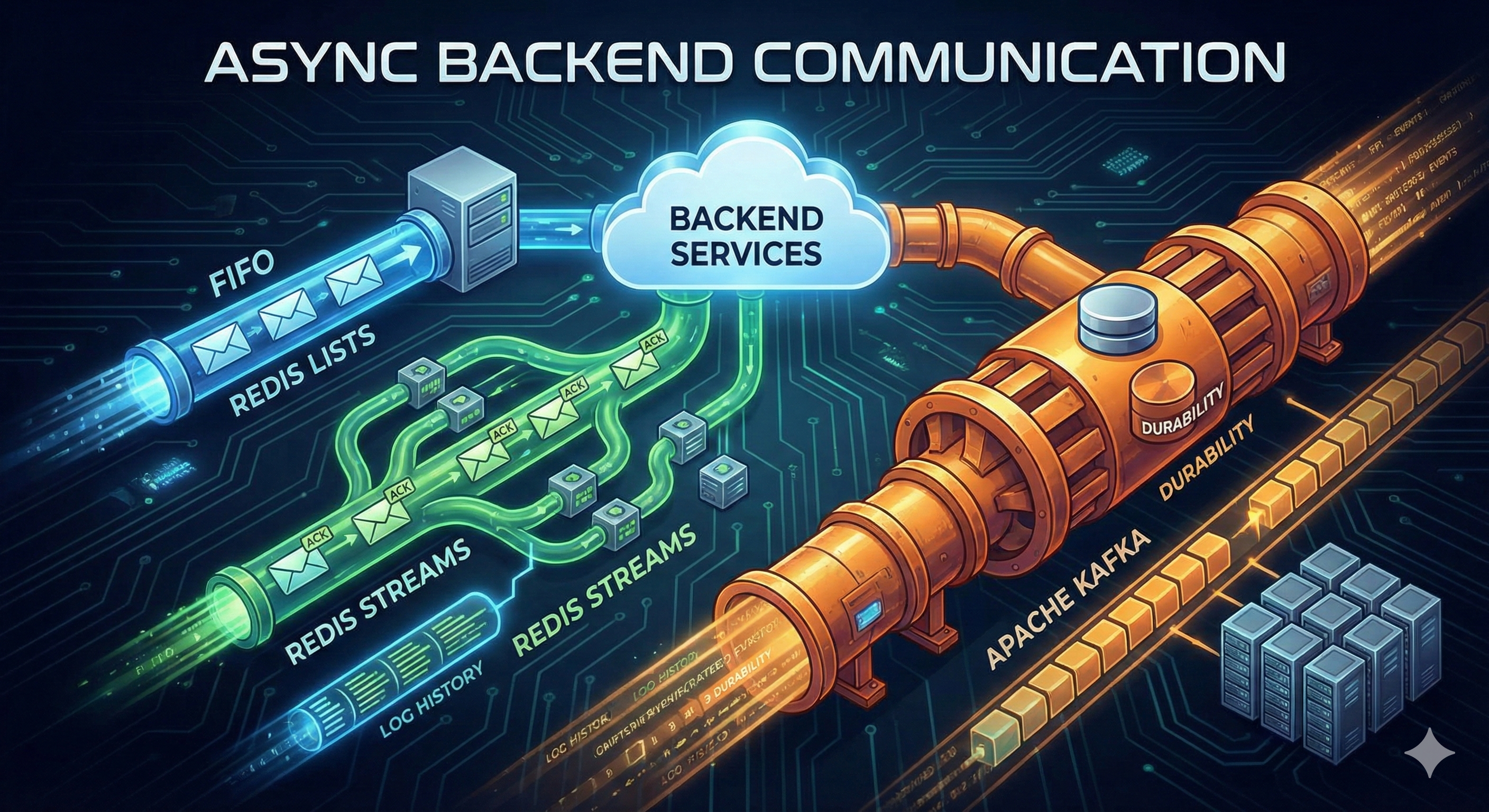
Asynchronous Backend Communication: Redis Lists vs. Redis Streams vs. Kafka
In modern backend architecture, moving from synchronous (request-response) to asynchronous communication is a natural evolution as systems scale. Whether you are decoupling microservices, handling background jobs, or building event-driven pipelines, the choice of the underlying message broker is critical.
The three most common contenders I've encountered in my projects are Redis Lists, Redis Streams, and Apache Kafka. While they all move data from Point A to Point B, they differ vastly in terms of durability, complexity, and guarantees.
In this article, we'll break down these technologies from a developer's perspective, analyzing their mechanics and mapping them to real-world scenarios like Exchange Systems, Zapier-like automation tools, and Uptime Monitors.
The Core Problem: Queues & Reliability
Before diving into the tools, it's important to understand what we are trying to solve. At a high level, queues facilitate communication between Producer and Consumer Groups (CGs).
The ideal queue needs to:
-
Distribute Load: Send events to all consumer groups, but distribute specific tasks equally among the workers within those groups.
-
Handle Failures: The number of workers is often a function of the number of events. If a worker goes down while processing a message, that message shouldn't be lost. This is where ACK (Acknowledgment) based queues become necessary.
-
Manage State: A common reliable pattern involves moving an event from an "Initial Queue" to a "Pending Queue" when picked up. It is only removed once acknowledged. If the ACK never comes (worker crash), the pending event can be reclaimed and reprocessed.
Let’s see how our three contenders handle these requirements.
1. Redis Lists (The Simple Queue)
Overview
Redis Lists are the simplest implementation of a queue. Using commands like LPUSH (Left Push) and BRPOP (Blocking Right Pop), you can create a fast, First-In-First-Out (FIFO) pipeline.
Strengths
-
Extreme Simplicity: Easy to reason about. It’s just a list of strings in memory.
-
Lowest Latency: Operations are executed in microseconds.
-
Zero Dependencies: If you are already using Redis for caching, you don’t need new infrastructure.
Weaknesses
-
Fire and Forget: By default, there is no built-in acknowledgment. Once a worker pops a message (RPOP), it is gone from the queue. If the worker crashes immediately after, that data is lost forever.
-
No Consumer Groups: You have to manually implement logic to distribute messages if you have complex routing needs.
Use Case: The "BetterUptime" Clone
In a monitoring application like a BetterUptime clone, the user is primarily concerned with live data. If the system lags and events become stale, they often lose their value (you don't need an alert that a server was down 10 minutes ago if it's up now).
- Why Redis Lists? In this scenario, speed is critical and strict data persistence is secondary. If stale events are dropped or lost during a crash, it is often an acceptable trade-off for the raw speed and simplicity of checking status in real-time.
2. Redis Streams
Overview
Introduced in Redis 5.0, Redis Streams bridges the gap between simple lists and complex logs like Kafka. It provides a persistent log of messages, consumer groups, and built-in acknowledgment (ACK) mechanisms, all while running in memory.
Strengths
-
Consumer Groups: Like Kafka, multiple consumers can read from the same stream without stepping on each other's toes.
-
Reliability: It supports XACK. Messages stay in a "Pending Entries List" (PEL) until the worker explicitly confirms they are done. If a worker dies, another can claim its pending messages.
-
Replayability: Unlike Lists, messages aren't removed when read; they stay in the history (until a limit is reached), allowing for debugging and replay.
Weaknesses
-
Memory Bound: Since Redis is in-memory, you cannot store terabytes of event history indefinitely. You must use MAXLEN to trim old events.
-
Complexity: The API (XADD, XREADGROUP, XCLAIM) is significantly more complex than simple Lists.
Use Case: The Exchange System
For a crypto or stock Exchange Platform, speed is the absolute priority. The matching engine usually needs to reside entirely in-memory to handle the order book efficiently.
- Why Redis? Redis Streams offers the perfect balance here. It provides the microsecond latency required to match orders instantly (which disk-based systems can't match) while still offering enough reliability (via ACKs) to ensure orders aren't simply dropped if a matching worker blips.
3. Apache Kafka
Overview
Kafka is a distributed commit log designed for high throughput and fault tolerance. Unlike Redis, it persists data to disk and is designed to handle massive scales of data with long-term retention.
Strengths
-
Durability & Retention: Kafka writes to disk. You can keep event logs for days, months, or years, allowing you to "replay" the entire history of an application.
-
Horizontal Scaling: Kafka partitions allow you to scale horizontally across many servers.
-
Event Sourcing: It acts as a single source of truth for the state of your system.
Weaknesses
-
Operational Complexity: Running a Kafka cluster (especially with Zookeeper, though KRaft is changing this) is a heavy operational burden compared to Redis.
-
Latency: While fast, it is generally slower than in-memory Redis because of network and disk I/O.
Use Case: The Zapier-Like Automation App
In a Zapier-like application, reliability is non-negotiable. If a user triggers a workflow (e.g., "When I get an email, save to Sheets"), that event must complete eventually.
-
Why Kafka?
-
Guaranteed Delivery: You cannot afford to lose a user's automation trigger just because a worker crashed or the queue overflowed.
-
Backpressure: If your workers are overwhelmed, Kafka can store the backlog on disk until your workers catch up. Redis might run out of memory in this scenario.
-
Strict Ordering: Kafka guarantees order within partitions, which is vital for multi-step automation workflows.
-
Conclusion: The Decision Matrix
Choosing between these three comes down to your specific constraints regarding Latency, Durability, and Complexity.
| Feature | Redis Lists | Redis Streams | Apache Kafka |
|---|---|---|---|
| Primary Goal | Simplicity & Speed | Reliability & Speed | Durability & Scale |
| Data Storage | In-Memory (Ephemeral) | In-Memory (Persisted log) | Disk (Persistent log) |
| Ack Mechanism | No (Fire & Forget) | Yes (XACK) | Yes (Offset Commit) |
| Ops Complexity | Very Low | Low | High |
| Ideal Use Case | BetterUptime Clone: Live data where staleness = irrelevance. | Exchange Platform: Microsecond latency with delivery guarantees. | Zapier Clone: Critical workflows where data loss is unacceptable. |
My Rule of Thumb:
-
Start with Redis Lists if you are building a simple side project or handling transient jobs.
-
Upgrade to Redis Streams if you need reliability (ACKs) and Consumer Groups but want to keep the infrastructure simple.
-
Reach for Kafka only when your data creates a "Data Platform," you need to replay history from days ago, or your scale exceeds what can fit in RAM.
Happy coding!